
Okay, I need to be honest with you. The first time I watched Neon Genesis Evangelion, I didn’t finish it feeling hyped or satisfied. I finished it feeling… hollow. Confused. A little bit broken. I sat on my floor, stared at my Gundam model kits, and thought, “What did I just watch?”
That’s the point.
Twenty-five years after it first aired, and now celebrating its 30th anniversary in 2026, Evangelion remains the most important, most analyzed, and most emotionally devastating mecha anime ever created. It didn’t just tell a robot story. It used giant robots as a scalpel to dissect the human psyche.
Let’s talk about the trauma legacy.

Before Evangelion: The Genre It Inherited
To understand what Eva did, you have to understand what came before. The mecha genre, by 1995, had two established lanes:
- Super Robot: Pure, heroic, emotional spectacle. Robots powered by courage and shouting.
- Real Robot: Gritty, political, tactical. Robots as weapons of war with real consequences.
And here’s the thing anime fans often miss: Gundam was already doing deconstruction. Amuro Ray, the hero of the original Mobile Suit Gundam (1979), was a traumatized teenager who had to be physically slapped back into the cockpit. Zeta Gundam (1985) ended with nearly its entire cast dead and its protagonist mentally broken.
But Gundam deconstructed war. It asked: “What does combat do to soldiers?”
Evangelion asked something worse: “What does existence do to a person?”
For a full breakdown of these foundational genres, our Real Robot vs Super Robot guide covers the territory Eva was about to explode.
The Premise That Wasn’t the Point
On paper, Neon Genesis Evangelion (1995) sounds like a standard mecha setup. It’s 2015, fifteen years after a global catastrophe called the Second Impact. A teenager, Shinji Ikari, is summoned to the city of Tokyo-3 by his estranged father. He arrives just as an Angel, a monstrous, invincible creature, attacks. He’s forced to pilot a giant bio-machine called an Evangelion to fight it. If he doesn’t, humanity ends.
Standard stuff, right?
Wrong. That plot is just the delivery mechanism. The show doesn’t care about the Angels. It doesn’t care about NERV’s secrets (well, it does, but that’s the B-plot). It cares about one question: What would actually happen inside the head of a child given this responsibility?
Psychological Deep Dive: What Is Evangelion Really About?
Let’s get clinical for a moment, because Eva demands it.
Shinji Ikari and the Hedgehog’s Dilemma
The show opens with Shinji literally refusing to get in the robot. For a mecha protagonist in 1995, this was unthinkable. He’s not brave. He’s not reluctant-but-willing. He’s terrified, passive, and profoundly convinced of his own worthlessness. The series uses the Hedgehog’s Dilemma, porcupines that hurt each other when they get too close, as a metaphor for human intimacy. Shinji craves connection but fears the pain it brings, so he runs. Over and over. That’s not a flaw in his character; it’s the entire point.
Asuka Langley Soryu and Masked Vulnerability
Where Shinji retreats, Asuka attacks. She’s loud, aggressive, sexually provocative, and the best pilot of her age. But every display of confidence is a carefully constructed wall. When the wall cracks, when she’s mind-raped by an Angel and forced to confront her own deepest fears about inadequacy and her mother’s rejection, she shatters completely. Her breakdown is one of the most brutal character arcs in animation history.
Rei Ayanami and Identity Fragmentation
Rei is the quiet, pale, emotionless girl. She’s a clone. She’s a vessel. She literally doesn’t know if she’s a person or a tool. Her existential question, “Who am I?”, is the same one the show forces the audience to ask.
Misato Katsuragi and Avoidance as Survival
Even the “adult” isn’t okay. Misato drinks, uses casual sex as avoidance, and projects her unresolved trauma with her father onto Shinji. She’s trying to save the world while drowning in her own unprocessed grief.
And behind all of it is director Hideaki Anno, who has openly discussed his clinical depression as the show’s creative fuel. He once described himself as “a broken man who could do nothing for four years.” Evangelion isn’t just about depression. It is depression, animated.
The Deconstruction: How It Broke the Genre
Here’s where Eva differs from Gundam’s earlier deconstructions. Gundam said, “War is hell, and it breaks people.” Evangelion says, “Life is hell, and it breaks people. The robot is irrelevant.”
The show actively rejects the premise of its own genre. The last two episodes abandon the plot entirely, confining Shinji to an abstract, minimalist soundstage where the other characters dissect his psyche in real-time. It’s not a “cope-out” due to budget; it’s a deliberate narrative suicide. The show stops being a show and becomes a form of group therapy.
Then came The End of Evangelion (1997), the feature-length alternate ending that’s even more punishing. It shows what happens in the real world while Shinji’s internal monologue plays out. Mass death, psychological violation, and a finale where Shinji rejects a world without pain but accepts that pain is preferable to nothingness. It is not a happy ending. It is a necessary one.
The Legacy: Post-Eva Anime
You cannot understand modern anime without understanding Evangelion‘s shadow.
It directly created the “sekai-kei” genre, stories where the protagonist’s personal psychological state is directly connected to the fate of the world. You see this in everything from Saikano to I Want to Eat Your Pancreas.
Its influence is explicit in:
- Attack on Titan: Traumatized children forced into impossible violence, existential horror, a deeply ambiguous ending.
- Code Geass: A master strategist with godlike powers and a Messiah complex.
- Madoka Magica: Magical girls deconstructed with the same psychological brutality.
- Wonder Egg Priority: Trauma manifested as monster-of-the-week battles.
- 86 -Eighty Six-: Children used as disposable weapons, grappling with dehumanization and identity.
And then there’s Gurren Lagann. If Evangelion is the depressive episode, Gurren Lagann is the manic rebound. It’s the direct answer to Eva, a show that says, “Yes, existence is meaningless. So make your own meaning by drilling through the universe with sheer willpower.” (We’ll have a full celebration of that masterpiece soon.)
Where to Watch Evangelion in 2026
If this has convinced you to finally experience (or revisit) the trauma, here’s the current streaming landscape:
The Original Series + The End of Evangelion
- Platform: Netflix (global)
- Details: Netflix acquired the global streaming rights in 2019 and continues to carry both the complete 26-episode series and the End of Evangelion movie . This is the easiest and highest-quality way to access the original story.
The Rebuild of Evangelion Films
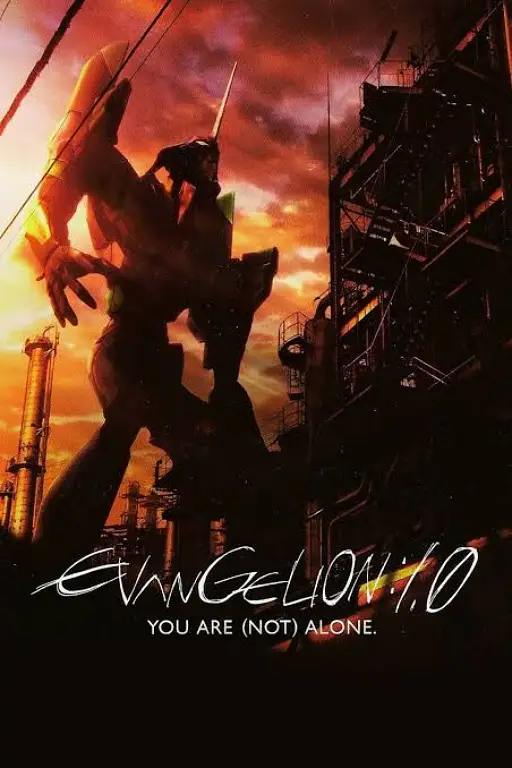
Platform: Amazon Prime Video (global)
Details: The four-film “Rebuild” series, 1.0 You Are (Not) Alone, 2.0 You Can (Not) Advance, 3.0 You Can (Not) Redo, and the finale 3.0+1.0 Thrice Upon a Time, are exclusively streaming on Amazon Prime Video. Note that Prime Video’s anime catalog has faced criticism for poor promotion and its controversial use of AI dubbing, but the Evangelion films themselves use professional human dubs.
30th Anniversary Note
- February 2026 marks 30 years since the series’ debut. A special Kabuki stage adaptation runs February 21–23 at Yokohama Arena, featuring all-male casts in elaborate costumes, reinterpreting Shinji and Kaworu’s story through traditional Japanese theater . Additionally, Japanese broadcaster TBS will air a television version of the Rebuild films on February 23 as part of the “Operation 0223” celebration .
Is It For You? The Honest Verdict
I’m not going to tell everyone to watch Evangelion. It is not a “fun” watch. It is not a “weekend binge.” It is an experience that will sit inside you for days, and not comfortably.
Watch it if:
- You’re ready for a mecha show that doesn’t care about mecha.
- You appreciate psychological character studies over plot.
- You want to understand the DNA of 70% of modern dark anime.
Skip it (or wait) if:
- You’re in a vulnerable mental space. Seriously. This show can be triggering.
- You need clear answers and tidy endings.
- You’re just getting started with mecha, go watch Gundam 00 first.
Your Mission, Should You Choose to Accept It
Neon Genesis Evangelion isn’t a comfort watch. It’s a mirror. It reflects whatever you bring to it, your fears, your avoidances, your desperate need for connection. That’s why, 30 years later, we’re still writing about it, still debating its ending, still using it as a reference point for every ambitious anime that follows.
It asked a question the mecha genre never thought to ask: What if the pilot doesn’t want to save the world? What if he just wants someone to tell him it’s okay to exist?
If you’re ready for that question, your cockpit is waiting. Just… maybe keep something soft to watch afterward. My heart needed it.
Disclosure: This article contains affiliate links. If you choose to buy through these links, ComicsDeck may earn a small commission at no extra cost to you.
